
|
|

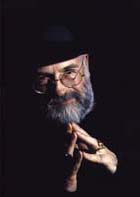
"This biography originally appeared in the Program book for the Discworld Convention 1996
Terry Pratchett: born 28th April 1948 Beaconsfield, Bucks. Major source of education: Beaconsfield Public Library (though school must have been of some little help). With his short story The Hades Business published when he was thirteen, Terry was obviously in line for a bright future. He joined The Bucks Free Press in 1965, and was writing reviews of our publications before I met him. He had interviewed my co-director Peter Bander van Duren regarding his book on education in the 1970s, and mentioned to him that he had written a book called The Carpet People and would we consider it for publication? Yes. It was a delight, and we published it in 1971, with a launch party in the carpet department of Heal's in Tottenham Court Road. It received few reviews, but those it did get were ecstatic, with it being described as being "of quite extraordinary quality" (Teacher's World) and "a new dimension in imagination and the prose is beautiful' (The Irish Times). What the reviews would have been like had reviewers seen the illustrations in colour - Terry hand coloured the illustrations in a handful of copies - can only be guessed. It was obvious that here was an author we had to publish.
The Carpet People was followed by The Dark Side of the Sun (1976) and Strata (1981), both written on dark winter evenings when Terry had nothing better to do. Having left The Bucks Free Press for the Western Evening Mail in 1970, he returned to it in 1972 as a sub-editor, and in 1974 joined the Bath Chronicle. (At this time he also produced a series of cartoons for our monthly journal Psychic Researcher describing the goings-on at the government's fictional paranormal research establishment 'Warlock Hall'.) In 1980 Terry was appointed publicity officer for the Central Electricity Generating Board (now PowerGen) with responsibility for three nuclear power stations ('What leak? -- Oh, that leak') where he was working when we published the first of the Discworld novels, The Colour of Magic, in 1983. Terry's paperback publisher at the time was New English Library, but they failed to market his works properly - their being taken over by Routledge at the time did not help matters - and I was able to get them to forgo their option for the next title, The Colour of Magic, and interest Diane Pearson at Corgi, and she in turn convinced the company to take it.
Corgi succeeded in getting BBC's "Woman's Hour" to broadcast it as a six-part serial, immediately after which NEL rang to ask whether the paperback rights were still free: of course, they were too late. Corgi's publication of the first Discworld novel was the turning point, and the BBC later broadcast his third novel, Equal Rites, also on "Woman's Hour". At the time, I was informed that no other books had generated so much reaction from their listeners.
The Light Fantastic was published in 1986, by which time it had become obvious to Terry and myself that if he was to maximise his potential, then he had to move to a major publishing house, as my company was incapable of coping with bestsellers, and that this should be done while we were friends. I suggested to a friend of mine at Gollancz, David Burnet, that they should consider taking Terry onto their SF list, and although they had never published fantasy before, only traditional SF, we initially struck a co-publishing deal for three titles, Equal Rites, Mort and Sourcery. With Terry's increased popularity, however, it became obvious that this arrangement would cause a conflict of loyalties for me, so it was terminated and I became Terry's agent. Thereafter, all Discworld novels were to be published in hardcover by Gollancz, while Corgi continued to publish the paperback editions (except Eric).
In September 1987, soon after he had finished writing Mort. Terry decided he could afford to devote himself to full-time writing, rather than merely doing so in his spare time after work: he thought he might suffer a drop in income for a while but that it would pick up in due course - and anyway, he enjoyed it more than fielding questions from the Press about malfunctioning nuclear reactors, so he resigned his position with the CEGB (about which he would write a book if he thought anyone would believe him). His sales - and income - picked up very much more quickly than he had expected, and his next Gollancz contract was for six books, with much larger advances. Since then, sales have continued to improve, and this year both Maskerade and Interesting Times were in the top ten hardcover and paperback lists of titles most in demand prior to Christmas, while Soul Music (published by Corgi in May 1995) spent an unbroken run of four weeks in the No.1 position on the paperback bestseller list. Recently I read that Reaper Man was the eighth fastest-selling novel in Britain in the past five years: a remarkable achievement for any book, let alone a so-called 'genre' novel!
Terry's books do not need listing here, but the latest Discworld novel is Feet of Clay, to be published in May. Suffice to say that Commander Sir Samuel Vimes, Captain Carrot and The City Watch feature much in this whodunnit, described by Gollancz as 'a chilling tale of poisoning and pottery'. This Spring will also see the publication of the third of the Johnny Maxwell novels, Johnny and the Bomb, as well as playtexts by Stephen Briggs, of Mort and Wyrd Sisters. September will also see the publication of a portfolio of Paul Kidby's illustrations, principally of Discworld denizens, with text by Terry, and in November, of course, Maskerade will appear in paperback.
Of his books for young readers, Truckers, the first volume of what is known in the USA as the Bromeliad Trilogy, was a landmark in that it was the first children's book to appear in the British adult paperback fiction bestseller lists, and in due course it was followed by Diggers, Wings, the revised version of The Carpet People, and both Johnny Maxwell books, Only You Can Save Mankind and Johnny and the Dead.
Terry has also written a number of short stories, two of which had Discworld themes. These stories involve him in almost as much work as a full-scale book, and if he is already writing a novel - which is almost all of the time - he finds it very difficult to stop and change tracks, as it were, and write a short piece, so there are fewer of that genre around than there might be.
When he took up his position with the Western Daily Press in 1970 he moved, with wife Lyn (whom he had married in 1968) and daughter Rhianna (born in 1976), to a cottage in Rowberrow in Somerset, but when he found he could not enlarge it further, the family moved in 1993 to what he described as 'a Domesday manorette' south-west of Salisbury, and alert fans will have seen pictures of this on the TV interview at the time Soul Music was published.
At the time this appears, Terry will have returned from another visit with Lyn to the original continent of XXXX, probably with a considerable part of another Discworld novel written as well as having been to North America. What next? I think he has promised to write another children's book for Doubleday, but much depends on what bright ideas have sleeted through the biosphere to trigger magnificent creation in that amazingly imaginative brain. (Very early on in the writing of the Discworld series, he had written the prologue of another SF novel as the beginning of what he planned to call 'The Long Earth Series', but it was decided there was still enough material to fill some more Discworld novels and 'Long Earth' was put on the back burner, where it still remains - though at some time in the future it may well be resurrected.)
His work for the Orang-Utan Foundation is common knowledge, but what is less well-known, except amongst its members, is that he has just finished a year's stint as Chairman of the Society of Authors.
Colin Smythe

The Discworld Novels
The Colour of Magic
The Light Fantastic
Equal Rites
Mort
Sourcery
Wyrd Sisters
Pyramids
Guards! Guards!
Eric
Moving Pictures
Reaper Man
Witches Abroad
Small Gods
Lords and Ladies
Men at Arms
Soul Music
Interesting Times
Maskerade
Feet of Clay
Hogfather
Jingo
The Discworld Companion
The Streets of Ankh-Morpork
The Discworld Mapp
Other Novels
Good Omens
Strata
The Dark Side of the Sun
Truckers
Diggers
Wings
Only You Can Save Mankind
Johnny and the Dead
Johnny and the Bomb
The Carpet People
The Unadulterated Cat